Terra Kundu – the red earth that shaped me


Terra Kundu means red earth.
Not just any earth. But earth that sticks. That gets under your nails and refuses to let go, even when you no longer walk on it. Red earth is memory. It is origin. It is something you carry, whether you want to or not.
My mother, Julia, left Angola at the end of the 1980s. She fled a war that consumed everything that was supposed to be safe. Her childhood was overtaken by violence. Her future became uncertain. Leaving was not a choice made out of desire, but out of necessity.

She arrived in the Netherlands with more loss than luggage. What she left behind was land, family, language in its purest form. What she brought with her was strength. Silence. And a deep knowing that her children had to have a different reality than the one she had known.
I was born in the Netherlands. Not on the red earth of Angola, but on cold, flat ground that did not know my history. And yet I grew up with stories coloured red. With voices that carried Portuguese like an echo of home. With women combing their hair while sharing memories too heavy for children, yet too big to remain unspoken.
I grew up in Rotterdam-West, among displaced people from the African diaspora. Mainly from the PALOP community — Angola, Cape Verde, Guinea-Bissau, Mozambique, São Tomé and Príncipe. We were children of displacement. Children of parents who had to dig up their roots in order to plant them again.
I learned early what it means to move between worlds.
At school I was Dutch. At home I was African.
Outside I adapted. Inside I felt depth.
I watched my mother work, carry, keep going. I saw how war does not always live in words, but in body language. In exhaustion. In overprotection. In silence at the dinner table. At the same time, I saw something else: community. Women holding one another. Cooking, praying, singing. Reminding each other who they were before they were called refugees.
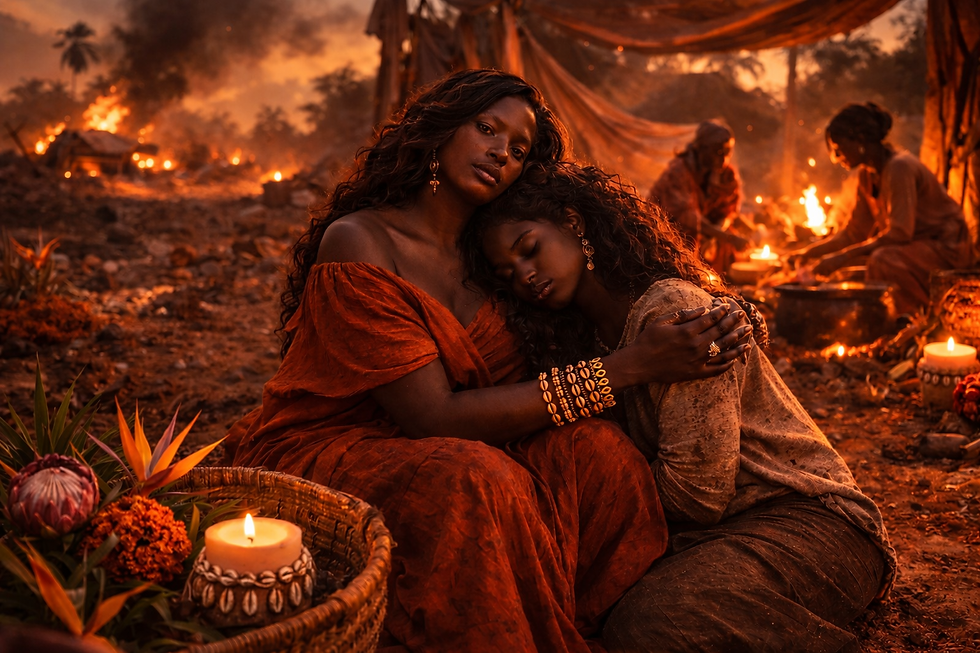
Out of that tension, Terra Kundu was born.
Not as a marketing idea. But as a necessity.
I wanted to create a place where our stories are not fragmented. Where the red earth is not wiped away to fit in better. Terra Kundu is my way of saying: we come from somewhere. Our mothers survived something. That lives in our blood, in our spirituality, in the way we gather.
Red earth became a metaphor for an identity that does not dissolve. For women who reinvent themselves without denying their origin. For a diaspora that is not only loss, but also creative power.
I carry Angola, even though I was not born there. I carry the Netherlands, even though I do not always feel fully of it.
Terra Kundu is the bridge between those two realities.
It is the recognition that displacement is not the end of a story. That my mother’s flight was not a rupture, but a shift of ground. That I, as the daughter of a woman who fled war, am not only heir to trauma — but also to strength.
Terra Kundu is my answer to the question:
Where do I belong
I belong in the red earth
Even if that earth is symbolic.
Even if that earth exists in memory, in ritual, in gathering.

You can leave your country.
But your origin does not leave you.
And so I build.
With clay. With words. With women.
Terra Kundu.
Red earth.
My beginning.
Comments